Works in English
.

Casablanca and Other Stories
MSU PRESS, 2007
Translated by Donald A. Yates
and Andrea G. Labinger
182 pages, 6 x 9 – Cloth, dust jacket
0-87013-768-9 (978-0-87013-768-6) World Rights
Edgar Brau, one of the most exciting South American writers to emerge in the past twenty years, debuts his first English-language collection with the publication of Casablanca and Other Stories.
The fiction of Edgar Brau draws not only upon the rich literary heritage of his native Argentina but also upon the body of work that has now rightly been formed into a South American canon, embracing those such as Jorge Luis Borges, Gabriel García Márquez, and Isabel Allende. He brings a unique perspective to his narratives — narratives forged in the political and social upheaval that has characterized modern South America. Employing a fantasy-like aspect that goes beyond magical realism, his work is reminiscent of Edgar Allan Poe in his use of atmosphere as an additional character. These short stories signal a new era, much as the publication of Jorge Luis Borges’ Labyrinths in 1962 heralded a coming-of-age for his generation.
This book includes a novella, Casablanca, translated by Andrea G. Labinger, and nine stories (from three of Edgar Brau’s collections: El Poema y otras historias, Dos historias fantásticas, and Tres cuentos) translated by Donald A. Yates, to bring to a fresh audience the work of a very major Argentine author.

Argentine Suite
Translated by Donald A. Yates
Forthcoming
The four stories collected in this book, while they are the product of imagination, contain in their structures certain real aspects of the repression instituted by the military government during the so-called Dirty War (1976-1983). The first, Grimaldi’s Christ, takes place at the Naval Mechanic School, one of the most infamous clandestine detention centers during this period, located in the Autonomous City of Buenos Aires. The second of the stories, The Child, has as its setting one of the many military barracks converted into detention camps and describes the process of dealing with pregnant prisoners. The third, Mandrake, describes the activity of paramilitary groups in houses that had been primitively remodeled to accommodate twenty or thirty prisoners. The last of the stories, The Key, has as its setting a military installation located in a rural area of the northern province of Tucumán, where operations were carried out by the Compañía de Monte of the E.R.P., a Marxist-Leninist organization.
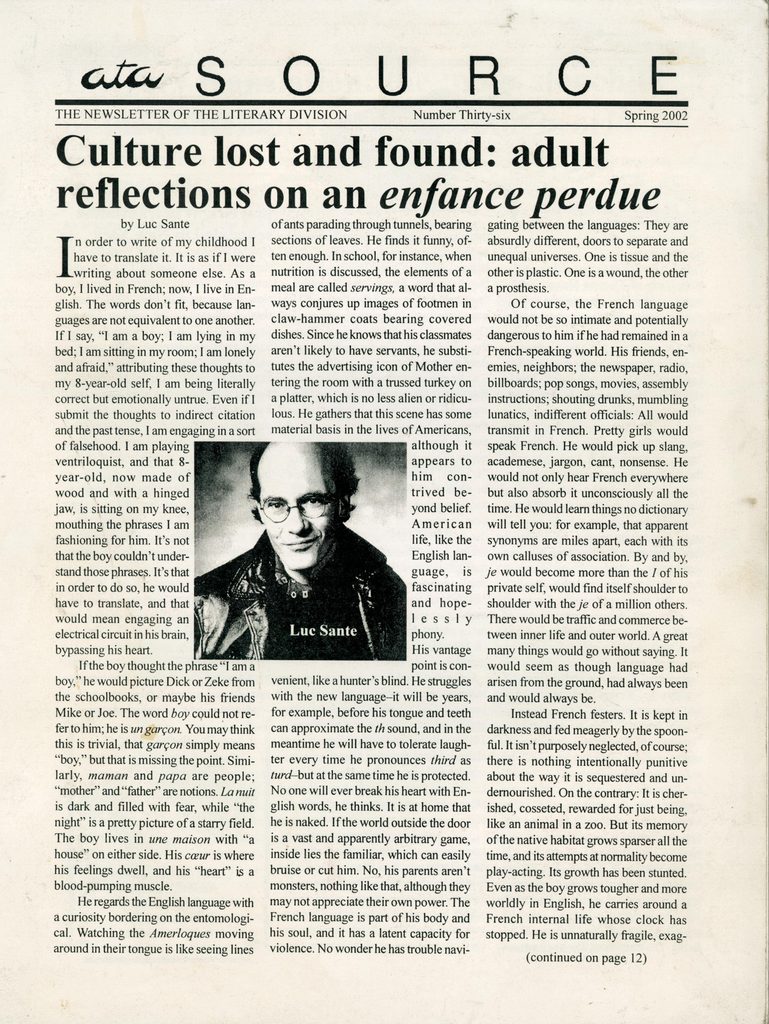
The Calendar
SOURCE – A.T.A.
Number Thirty-six, Spring 2000
Translated by Donald A. Yates
“Every day, around dusk, the man would quietly enter the neighborhood bar and, leaning on the counter, ask for a brandy. He was short in stature, rather thin, mild-mannered, and well along in years. His face, barely distinguished by the mustache of an outmoded style, spoke more of loneliness than of the years. He wore a wrinkled brown suit. But otherwise gave the impression of careful concern for neatness. A weakened heart had forced him into early retirement, and since that time he had lived alone in a room in a nearby boardinghouse.”

The Siesta
ELLERY QUEEN MYSTERY MAGAZINE
June 2000
Translated by Donald A. Yates
“Seated on the dirt floor, the young boy wiped away the saliva from his lips and looked up at his grandfather, who was dozing in a hammock chair facing the doorway. The sounds of the clucking hens in the back yard and the rattle of the dishes that his grandmother was washing in the next room were clearly carried on the hot, humid air. The noise and the heat easily penetrated into the room through the loosely fitted slats of the door, making the old man´s slumber seem imperturbable. The boy decided to try raising his voice a little.
«Grampa, tell me where you put the ball. Can you hear me, Grampa?» he repeated wearily, his gaze cast down on the stick he was using to dig at the earthen floor.”
Bárcena’s Dog
TWO LINES
Cells – 2001
Translated by Donald A. Yates
“«So, my Colonel, what do we do with the savage?»
One-Eyed Bárcena, officer in charge of a division of Oribe’s forces that was bivouacked at that moment in San Nicolás de los Arroyos, felt a twinge of anger and with his one good eye sought out the insolent fellow who had broken the silence. But as he looked up and down the orderly line of red uniforms, he realized that in truth it had been less the result of impudence than the desire on the part of the entire camp to know once and for all what their leader’s decision would be. He suspended his search and turned again to the man, guarded by two soldiers with lances, who stood a few paces away before his tent. Once more he scrutinized the blue eyes, the long graying hair that was plastered to his sweaty brow, the beard trimmed in the shape of a “U”, which labeled him as a Unitarian, the clothing of a man of breeding, and thought to himself that if it were merely a matter of punishing him for the poisoned bread that he had delivered to the camp that morning, just a few jabs with the tips of those lances would do, producing a slow loss of blood, or perhaps the best solution might be simply having his throat cut.”
The President’s Blessing
BEACONS
Number eight, 2002
Translated by Donald A. Yates and Joanne M. Yates
“Our Presidential residence is situated in the very center of the Capital, and two or three blocks of luxurious mansions surround it like protective rings. Continuing outward from these homes, the humbleness of the outlying dwellings accelerates at an extraordinary pace. At a distance of five blocks they are little more than shacks, and at the periphery, they are miserable hovels.
A geometric garden, dotted here and there with flower beds, encircles the central building —almost a hundred years old and ornately Italian. For some time now, the garden has attracted the gazes and murmurings of the citizens on account of a strange ceremony that unfolds on its paths each evening. What happens is that as soon as he finishes his dinner, the President goes out into the garden accompanied by an aide-de-camp who carries a silver tray with a revolver on it. When they arrive at the head of the main path, the aide-de-camp presents the tray to the President, who, in the meantime, has pulled on some silk gloves. The President takes the gun, examines it, nods in approval, and then, as he begins strolling around the grounds, fires it overhead.”

The Prisoner
THE LITERARY REVIEW
Fall 2002
Translated by Donald A. Yates
“The door creaked open and two guards entered, leading a prisoner. After removing his clothes, they strapped him down on a wooden table and left. The prisoner, a middle-aged man with his hair receding at the temples, did not appear to have been beaten. He looked up at the ceiling and to the left and right with an expression of surprise, as if he had just awakened in a strange place. Suddenly, in the darkness at the far end of the room, the figure of a man in a gray smock stood up. He had been there from the first, but the prisoner had not noticed him. He raised his head to look in his direction. Then the man sat down again in the same place. He remained there for a few seconds, then removed a wrinkled rag from the pocket of his smock and smoothed it out. He approached the table and tied it around the head and through the mouth of the prisoner, who saw only a vague form with the outline of what might have been a mustache moving quickly above him before it disappeared into the darkened corner. The man sat down, lit a cigarette and from there began to blow smoke toward the prisoner.”

The Poem
NIMROD
Spring-Summer 2002
Translated by Donald A. Yates
You have exhausted the years
and have exhausted you,
and you still have not written the poem.
J. L. BORGES, Matthew, XXV, 30
“When the author of Gizeh (the “Maestro,” as everyone called him) received his fifth or sixth doctorate from one of the most important universities abroad, I, a mere admirer of his work, determined to meet him personally. I knew it wasn’t hard to arrange an interview and in some cases all it took was a phone call. My first attempt, however, failed. A woman’s voice informed me that for the time being, the writer had suspended all new commitments. If I cared to, I could phone him later on.”
The Journey
TWO LINES
Parties – 2003
Translated by Donald A. Yates
Etonnants voyageurs!
Baudelaire, Le voyage, III
“At the hour when night seems to gather in its tapestries to the tinkling of frozen crystal, and the weakest of the stars throw themselves toward the still-darkened earth, terrified by the inminent catastrophe of daybreak, at that hour, propitious for the plotting of outrageous things and for the bubbling up of fantasy, precisely at that hour, the brief tolling of a bell, sterile and seemingly veiled in cobwebs, shook the sleeping town. Just when the familiar silence of the ordinary is about to return, another peal, equally brief, rouses the sleepers, whose drowsy attention is immediately solicited by two or three additional tollings that seem to be testing the metal integrity of the bell. But after another especially intense stroke of the clapper, followed by others in hurried succession, the bell emits a high-pitched and continuous boom that, turning its sound waves into a lengthened serpent, begins first to course through the town’s streets with implacable sinuosity, and then, by means of its necessary and repeated forkings, assaults the doors, rattles tehe windows and, slipping through cracks, draws out into the streets with the furor of a wartime levy the amazed occupants who do not yet understand but nonetheless cannot ignore the irresistible command of the bell that back at the station continues to toll.”

The Forgotten God
THE ANTIOCH REVIEW
Dreams and Dreaming
Summer 2003
Translated by Donald A. Yates
There are four legends concerning Prometheus… According to the third, his treachery was forgotten in the course of thousands of years, forgotten by the gods, the eagles, forgotten by himself.
KAFKA, Prometheus
“There were no longer wounds, nor eagles, nor chains. The rock had dissolved into thin air.
The light was gone and no sound could be heard. But within the perfection of that emptiness, isolated like a germ, a consciousness throbbed.
It was a fragile movement, a readjustment amid that timeless lethargy. The faint perception of something located outside time but that nevertheless seemed immersed in it, that in some way had always been there… But nothing definite could yet be sensed. It was only the delicate impression of a stirring, of a quivering, communicated by some kind of shallow wave that flowed inward, breaking, exhausted and meticulous, in the very center of that still unknowing conscience.”

The Child
THE LITERARY REVIEW
Winter 2004
Translated by Donald A. Yates
“The sound of footsteps halted outside the door, followed by loud rapping and then a voice that shouted:
«Hoods on! Hoods on!»
Inside the room the five women, stretched out on ragged mattresses, their hands and feet in chains, sat up and covered their heads with the black fabric hoods that lay at their sides. After a moment, during which someone looked through the peephole into the room, the door opened and in stepped a sergeant and his aide. The latter was carrying a serving bowl and a pile of tin plates; the sergeant held a half-filled black plastic garbage bag.
«Well, well, now. And how are our little widows? Everyone hungry?» the sergeant asked, as the other soldier began to ladle out some sort of stew onto the plates. He set down the plastic bag in the midst of the mattresses, which were laid out in a circle.
The women remained motionless.
The soldier placed the plates in front of the women, together with wooden spoons, and covered the bowl.
«Ready, Private?»
«Yes, Sergeant.»
«Then let’s go.»

Woodstock
WORDS WITHOUT BORDERS
January 2007
Translated by Michele MacKay Aynesworth
“Look: it happened here.
A sense of surfeit grew
from the unfeeling past—
Paternal Moneymen, whose alphabet
lay buried in the mud rosettas
where pigs leave their traces;
the torch-eyed eagle
passing crooked judgment
in careless corners of history;
the bomb’s early light;
the day leaning more and more,
by imperial equation, on the blind man’s stick,
enforcer of night’s might.”

The Journey
NEW WORLD, NEW WORDS
Recent Writing from the Americas
A Bilingual Anthology – 2007
Foreword by Gregory Rabassa
Translated by Donald A. Yates
Etonnants voyageurs!
Baudelaire, Le voyage, III
“At the hour when night seems to gather in its tapestries to the tinkling of frozen crystal, and the weakest of the stars throw themselves toward the still-darkened earth, terrified by the inminent catastrophe of daybreak, at that hour, propitious for the plotting of outrageous things and for the bubbling up of fantasy, precisely at that hour, the brief tolling of a bell, sterile and seemingly veiled in cobwebs, shook the sleeping town. Just when the familiar silence of the ordinary is about to return, another peal, equally brief, rouses the sleepers, whose drowsy attention is immediately solicited by two or three additional tollings that seem to be testing the metal integrity of the bell. But after another especially intense stroke of the clapper, followed by others in hurried succession, the bell emits a high-pitched and continuous boom that, turning its sound waves into a lengthened serpent, begins first to course through the town’s streets with implacable sinuosity, and then, by means of its necessary and repeated forkings, assaults the doors, rattles tehe windows and, slipping through cracks, draws out into the streets with the furor of a wartime levy the amazed occupants who do not yet understand but nonetheless cannot ignore the irresistible command of the bell that back at the station continues to toll.”

Grimaldi’s Christ
THE DIRTY GOAT
Number 23 – Fall 2010
Translated by Donald A. Yates
“He remembered (and the rain outside lent a touch of complicity to the evocation) Naval Captain Prieto remembered, with his gaze fixed on the image of Christ crucified that hung on the wall behind his desk, the first masses of his childhood in the chapel of the religious school that he had been transferred to. He remembered his surprise at that world of devotion that he had just been introduced to and his no less surprising and immediate embracing of it. He remembered above all the large sorrowful Christ, next to the main altar that, amidst flickering candles and the tinkling of bells, lifted His clouded eyes to the high vaulted ceiling, as if seeking an opening through which He could best accomplish His ascension into Heaven, a miracle celebrated in ceremonies —one that would leave behind for those who wanted to accompany Him (such was his own case) the empty cross. From his pew he would follow that gaze, but not seeing anything other than shadows high amid the exquisite carvings, he lowered his glance to the Savior’s eyes that perhaps disconcerted by the unbroken ceiling, had lost some of their fixed appearance; the eyes no longer merely stared, the lips parted slightly and the hands seemed on the point of closing around the nails and ripping them out. On the observer’s part, however, it took only a blink of his eyes, a minimal distraction, for that fantasy to disappear and for the anguished gaze to continue raised above, unaware of the illusion that below, in one of the pews, it had dispersed.”

The President’s Blessing
Argentina, A Traveler’s Literary Companion
Whereabout Press, Spring 2010
Translated by Donald A. Yates
“Our Presidential residence is situated in the very center of the Capital, and two or three blocks of luxurious mansions surround it like protective rings. Continuing outward from these homes, the humbleness of the outlying dwellings accelerates at an extraordinary pace. At a distance of five blocks they are little more than shacks, and at the periphery, they are miserable hovels.
A geometric garden, dotted here and there with flower beds, encircles the central building —almost a hundred years old and ornately Italian. For some time now, the garden has attracted the gazes and murmurings of the citizens on account of a strange ceremony that unfolds on its paths each evening. What happens is that as soon as he finishes his dinner, the President goes out into the garden accompanied by an aide-de-camp who carries a silver tray with a revolver on it. When they arrive at the head of the main path, the aide-de-camp presents the tray to the President, who, in the meantime, has pulled on some silk gloves. The President takes the gun, examines it, nods in approval, and then, as he begins strolling around the grounds, fires it overhead.”

The Key
WORDS WITHOUT BORDERS
Beyond Borges: Argentina Now
October 2010
Translated by Donald A. Yates
“As soon as the patrol vehicle passed through the entrance to the barracks courtyard, the lieutenant in charge leaped from the vehicle before it had stopped, ran over to the officer who was waiting for him with a group of other soldiers, and, coming to attention and saluting, reported on his mission.
«One of our soldiers wounded, Colonel. Two guerillas dead and four captured,» he said hurriedly, as the two trucks at the head of the patrol drew up before the building.
The colonel, a tall, heavy-set man with his face freshly shaved, ordered the lieutenant to stand at ease and went over to one of the trucks. Covered with blood and dust, the bodies of the two guerillas were lying on their backs, already attracting a swarm of green flies.
«Unload the bodies,» he said to the soldiers of the patrol who were standing over the corpses, and moved to the other truck where, alongside the cuffed prisoners, were the wounded soldier and several of his companions.
«Get that garbage out of here immediately,» he said to the soldiers, nodding in the direction of the prisoners, and then stood aside, waiting for his order to be carried out.”

The Golem Project
THE ANTIOCH REVIEW
The Physics of Speed – Fall 2010
Translated by Andrea G. Labinger
“Now, slightly more than a month since the Council announced the conclusion of The Golem Project, it is possible to verify that the outrageous suppositions and groundless allegations provoked by the revelation at the time still persist, creating a state of anxiety in which uneasiness and suspicion dangerously combine. Misinformation, misinterpretations, omissions, and conjectures daily establish a foundation on which the Project’s origins, its results, its future, and even the punishment that the creature –the Golem– must face, all fade in a haze of imprecision, or worse yet, ambiguity. As one of the representatives of the Council before the scientists in charge of the Project, I believe it might not be without merit to interrupt the current scandal (the current chaos) with this personal report. Perhaps a precise spatial and temporal index of the Project and its development may serve to lessen, even indirectly, the blows of the dark, powerful current that alarms and overwhelms us today.”
******